As a child, I spent a lot of time alone in the wilds, immersed in a land of wonder.
I would lose myself in stories and possibilities, with no one there to tell me what was real and what was imaginary. In these worlds, I could embark on grand adventures, live incredible lives, and imagine wondrous stories. Sometimes there were dangers lurking in the shadows, but I was always protected by my friends in the forest—beings I would come to know much later as the Wedeme, the beings of the wilds.
These worlds were an escape from a reality in which I often felt isolated and unseen. They were also, I now understand, the beginning of my relationship with the otherworld
Forgetting the Wild
As childhood shifted toward adolescence, my sensitivity to the otherworld was gradually suppressed in favor of fitting in. I decided my childhood experiences were simply an active imagination. I dismissed the gifts that had been bestowed upon me and focused on becoming “normal.”
No more talking to the wilds.
No more mysteries at the edges of reality.
No more listening to the things I could sense but could not explain.
Instead, I learned how to blend into the social systems around me. I went to school, entered adulthood, worked ordinary jobs, and became a productive member of society.
I was also deeply depressed.
Being “normal” required me to suppress enormous parts of myself. By the time I understood the cost of that suppression, I no longer knew the parts of myself I had abandoned.
So I began the long journey home.
Finding my way back to myself
My healing began with therapy.
I moved between jobs and relationships, slowly learning to recognize which parts of my life were nourishing and which were performative. I began trading the things that no longer fit for dynamics that allowed me to become more fully myself.
With my house in order, so to speak, I was finally able to turn toward spiritual healing.
I began with meditation, yoga, and exploring energy exchange in private, personal settings. I deepened these practices over time, first through a 10-day Vipassana retreat, which expanded my meditation practice and my capacity to sit with myself, and later through a three-week Tantra/Kundalini teacher certification, which expanded my toolkit for expression, embodiment, and healing.
As I healed from trauma and learned how to live more authentically, the medicine I had carried as a child began to return.
The awakening
The first major surge came through a Kundalini awakening during an OSHO meditation. The meditation shook loose trauma held in my body, allowing me to reclaim an aspect of myself that had been cast away in a moment of violation and trauma.
Then the Kundalini energy moved through me.
My whole body shook and tensed. And in the midst of it, I experienced a profound sense of connection with the universal consciousness of humanity and the cosmos.
It took months to integrate what had happened.
Every time I meditated, Kundalini would rise again. Grief from trauma I had previously been unable to access began moving through me. My body changed. I lost the ability to drink alcohol. My sensitivity intensified to the point that reintegrating into ordinary society became difficult.
I was learning that awakening is not always gentle. Sometimes the door opens before you know what is waiting on the other side.
Becoming a diviner
Ten months into this integration, I attended a consciousness conference at Oxford University with my spouse, where we shared a workshop we had developed around increasing and exchanging energy as a group experience.
At the conference, I participated in a grief ritual.
During the ritual, I felt my ancestors surrounding me and pouring their grief through me to be processed. The experience was extraordinarily intense and deeply dysregulating.
Afterward, I continued sensing beings from what I had come to understand as the otherworld. They were coming to be at all hours, waking me from my sleep, following me throughout my day.
A long-dormant ability had awakened, but I had no idea how to control it or work with these beings safely.
Overwhelmed by the call of the otherworld, I began working with the facilitator of the grief ritual as a mentor. This marked the beginning of my journey into divination and my training within the Dagara lineage.
Learning to work with medicine
My journey with my mentor taught me how to understand my medicine and step into my power. I wasn’t necessarily taught how to communicate with the otherworld so much as I was taught how to cultivate safety in my body—something I now understand as essential to meaningful medicine work.
With this foundation, I was able to open more fully to the otherworld and develop relationships with the beings I encountered: my ancestors, spirit guides, the Divine Feminine Mother Goddess, and the Wedeme.
And then something remarkable happened.
I remembered.
The relationships that had formed in childhood were still there. The beings of the wilds welcomed me back like an old friend.
In November 2025, I merged with the Wedeme and became a Stick Diviner.
Since then, my ancestral medicine has continued to flow through me, weaving itself together with the healing practices I discovered throughout my own journey. The things I once thought I had imagined became part of the medicine I now carry.
Why the Sea Hag?
Soon after embracing my path as a medicine woman, I heard the story of a Selkie woman who lost her seal skin.
In the story, a woman is tricked by a man who steals her seal skin and marries her, promising to return it after seven years so she can go back to the sea. Instead, he betrays her. Her skin is destroyed, and she faces the devastating possibility that she may never return to her true form.
And yet, she keeps looking for a way home.
Eventually, she seeks out the Sea Hag.
The Sea Hag lives at the fringes of society, deep in the cliffs overlooking the sea, weaving the stories of time into a tapestry.
She is wise and wild.
She speaks the truth regardless of how it is received.
She does not solve problems for people.
She illuminates the path so they can find their own way forward.
The Sea Hag is not the main character of the story.
She is the plot device that makes it possible for the heroine to become the author of her own next chapter.
That is the medicine I want to offer.
Becoming the Pacific Sea Hag
When I first heard this story, I was immediately enamored with the idea of becoming the Sea Hag.
At first, I thought I would have to wait.
I wasn’t old enough. I certainly didn’t possess all the world’s knowledge. I wasn’t omniscient, with an understanding that stretched beyond space and time. And, frankly, I couldn’t even weave a tapestry yet.
But the archetype stayed with me.
Then, living in the wilds and cultivating a daily relationship with the otherworld, I realized something:
Perhaps I don’t need to fulfill every expectation of the role today. Perhaps becoming the Sea Hag is a path, not a destination.
One day, I will be old enough.
One day, I will have woven many more stories into my tapestry.
For now, I am walking the path.
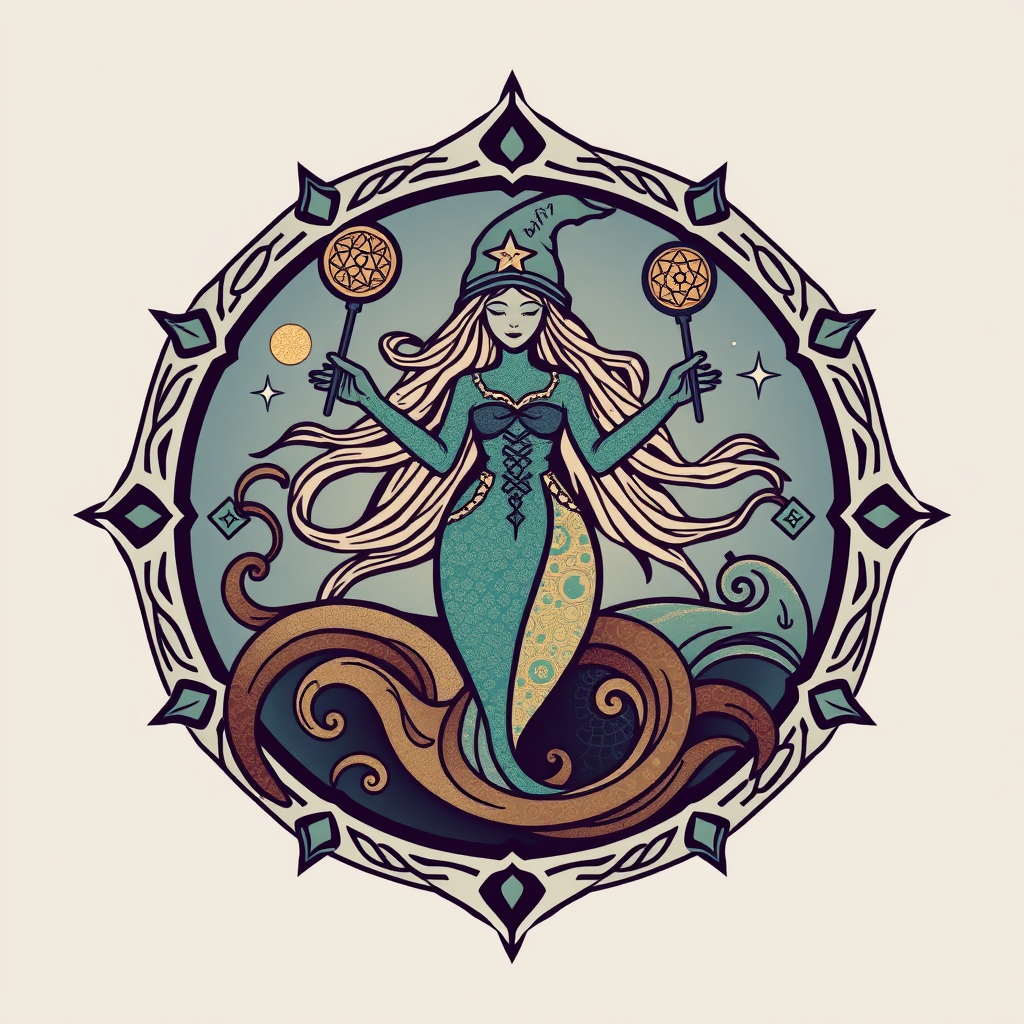
And so I claimed the name Pacific Sea Hag, in honor of the archetype I aspire to become.
A medicine woman.
A diviner.
A keeper of wild wisdom.
A companion at the threshold.
I work with the medicine I have gathered through my own journey—ancestral medicine, divination, energy work, embodiment, and the healing practices that helped me return to myself.
I don’t believe I can tell you who you are or what your path should be.
But I can help you listen.
I can sit with you at the edge of the known and the unknown, illuminate what is asking to be seen, and help you find the path back to your own sovereignty.
You are the one who gets to walk it.


